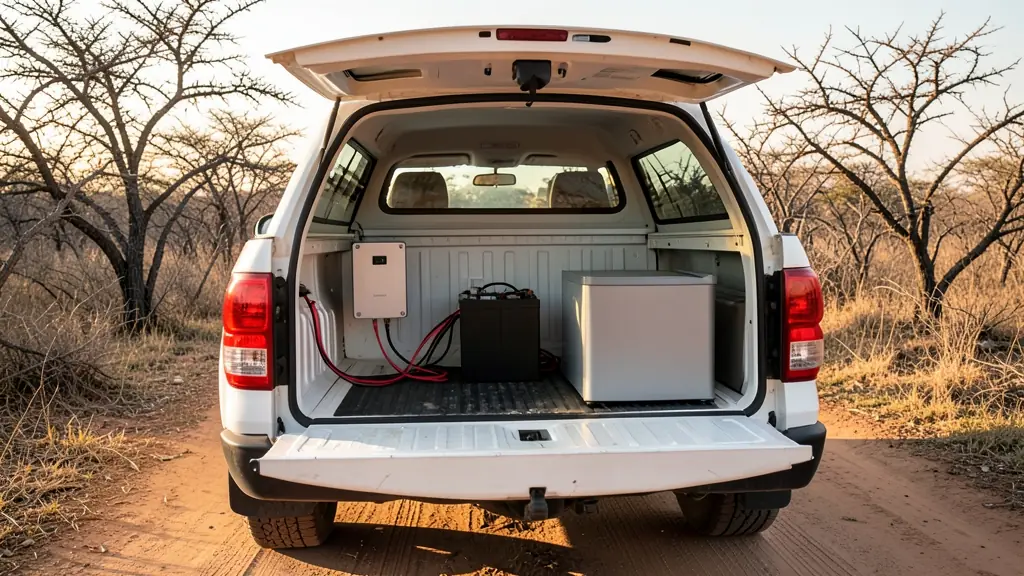
A power inverter turns 12 V or 24 V DC from a battery into 230 V AC, so you can run ordinary appliances in a car, a bakkie, a boat, a caravan or a camp. It is an inverter without a battery: you supply the battery. This page covers modified versus pure sine wave, continuous and surge watts, cable thickness and fuses, how fast an inverter drains a battery, and what to look for in a power inverter for sale. One request brings free quotes from local suppliers, with no obligation to accept.
Modified or pure sine wave
A modified sine inverter makes a stepped version of mains power. It is cheaper and runs simple loads such as phone chargers, lights and some power tools. But fridges, motors, laptops with active power supplies, CPAP machines, sound gear and anything with a timer or a variable speed motor can hum, run hot or fail on it.
A pure sine wave inverter makes power as clean as the mains, and runs almost anything within its rating. For a camping fridge, a laptop, a TV or medical equipment, buy pure sine. The price gap has narrowed, and a cheap modified unit that ruins an appliance is not a saving.
Continuous and surge watts
The continuous rating is what the inverter can deliver for hours; the surge rating is a short burst for motor starts. Size by continuous watts with headroom, and check the surge for anything with a compressor or motor. A 300 W unit suits laptops and chargers. A 1,000 W inverter, the common size for a bakkie or camping setup, runs a small fridge, a TV and lights, but must be wired straight to the battery. Above that, 2,000 to 3,000 W units run power tools and a microwave but need a big battery bank, often at 24 V.
Cable thickness, fuses and fitting
At 12 V an inverter draws large currents: roughly the watts divided by the voltage, so 1,000 W pulls over 80 A from the battery. Thin cable gets hot and wastes power. A safe fit has:
- Short, heavy battery cables of the size the maker specifies.
- A fuse or DC breaker close to the battery positive.
- Lugs crimped properly, not twisted wire.
- Airflow around the inverter, out of rain and dust.
- Cigarette lighter socket use only for small units, as the socket's fuse limits the load.
Battery drain and the right battery
An inverter empties a battery faster than people expect. A 500 W load on 12 V draws over 40 A, so a car starter battery can be run flat, and damaged, within an hour or so, leaving you unable to start. A second deep cycle or lithium battery, charged through a split charge unit or a DC to DC charger, keeps the vehicle battery for starting. See 12V and 24V lithium batteries and deep cycle batteries. For backup at home, a ready-built inverter trolley is simpler. Never connect a power inverter into house wiring.
What to include in your request
- What you want to run, with watts
- 12 V or 24 V battery, and its type
- Pure sine or modified sine
- Where it will be mounted
- Whether you need cables, a fuse and fitting
Power Inverters (12V to 230V) for different clients
- Homeowners: a pure sine inverter and deep cycle battery for the TV and lights in a pinch
- Complexes, estates and body corporates: an inverter in the security patrol vehicle for radios, chargers and a spotlight
- Offices and home offices: an inverter in a company car or bakkie for laptops and site equipment
- Shops, restaurants and salons: an inverter in a food truck or market bakkie for a card machine and lights
- Farms and smallholdings: an inverter in the farm bakkie for power tools, a fridge and a spotlight
- Clinics, surgeries and care homes: pure sine inverters in mobile clinics and ambulances for approved medical equipment
- Factories, warehouses, schools and churches: inverters in service vehicles and workshops for power tools and test equipment
- Electricians, installers and security companies: auto electricians and installers buying inverters, cables and fuse kits for fitting
Frequently asked questions
What size power inverter do I need for my car?
Can I use a power inverter without a battery?
How much does a power inverter cost?
Will you fit an inverter in my bakkie?
Power Inverters (12V to 230V) by province and city
- Johannesburg
- Pretoria
- Centurion
- Midrand
- Sandton
- Randburg
- Roodepoort
- Krugersdorp
- Randfontein
- Germiston
- Boksburg
- Benoni
- Kempton Park
- Alberton
- Vanderbijlpark
- Vereeniging
- Durban
- Pinetown
- Pietermaritzburg
- Richards Bay
- Newcastle
- Ladysmith
- Gqeberha (Port Elizabeth)
- East London
- Kariega (Uitenhage)
- Mthatha
- Cape Town
- Bellville
- Paarl
- Stellenbosch
- George
- Worcester
- eMalahleni (Witbank)
- Middelburg
- Secunda
- Mbombela (Nelspruit)
- Rustenburg
- Brits
- Klerksdorp
- Potchefstroom
- Mahikeng
- Polokwane
- Tzaneen
- Kimberley
- Upington
- Bloemfontein
- Welkom
- Sasolburg